

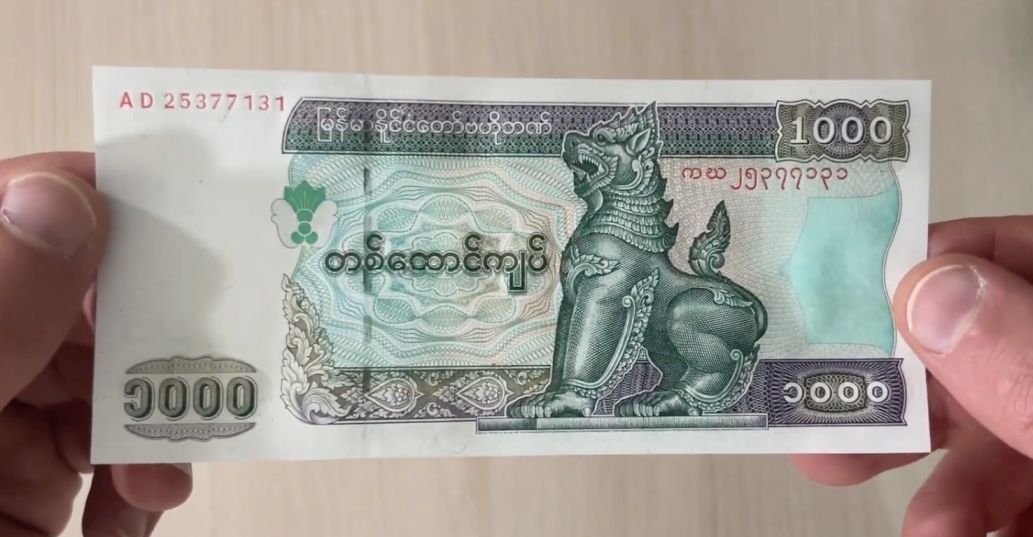
The official currency in Myanmar is the Kyat (pronounced “Chat”). Moreover, banknotes include denominations of K1, K5, K10, K20, K50, K100, K200, K500, K1,000, K5,000, and K10,000, while coins cover values of K100 and below. Travelers should familiarize themselves with these notes and coins when handling Myanmar Kyat during their visit.
Currency of Myanmar, the Kyat
Kyat is the official currency of Myanmar to which pronounced as Chat” by Burmese. The Kyat’s denomination and banknotes are printed in 50, 100, 200, 500, 1000, 5000, 10,000 and the newly introduced banknote, the 20,000 Kyat.
Additionally, the kyat is subdivided into 100 pyas (pronounced pjá), coins denominated in pyas have not been circulated since 1959 and the Myanmar currency is presented with the symbol K or MMK. The Pya coins are very rare in the market, however, you ca still use them if you have any. The most common banknote is the 200K use to pay for bus fare.
Currency, Credit Cards, and Changing Money in Myanmar
Things are evolving rapidly in Myanmar’s financial landscape. Once a country with minimal banking infrastructure, Myanmar now features numerous small banks, and ATM machines have become common in many urban areas. However, international banking services still remain limited, and many locals have yet to fully benefit from recent financial changes. As a result, cash continues to play a crucial role in daily transactions.
Myanmar uses the Kyat (pronounced “chat”) as its official currency, yet people across the country also widely accept the US Dollar. When planning your trip, don’t rely entirely on credit cards or ATMs, as these services can be unreliable outside of major cities. Instead, carry most of your spending money in cash—preferably in US Dollars. Bring bills in pristine condition, mostly in higher denominations to secure better exchange rates with money changers. Still, pack a few small-dollar bills for tips or minor purchases.
Furthermore, avoid exchanging money at airports unless you’ve pre-ordered your currency to lock in favorable rates. For better value, order your foreign currency in advance and collect it from a provider’s branch or request delivery. Services like the Post Office’s pre-ordering system offer competitive rates and convenient pickup. Additionally, use currency comparison websites to find the best exchange rates before your departure.
Best Pre-Paid Cards for Myanmar
While cash—especially in US Dollarsor THB (Baht of Thailand)—is still the most reliable currency in Myanmar, some hotels and restaurants now accept credit cards. However, due to limited international banking support, the safest and most convenient way to carry money is through a prepaid travel card.
Prepaid credit cards offer a modern alternative to Traveller’s Cheques, which are becoming obsolete. Moreover, these cards provide better security and control while traveling. One of the best pre-paid cards for Myanmar is the Caxton FX Global Traveller Card, which allows you to lock in exchange rates just 2.75% below the interbank rate. You can also use the card to withdraw local currency from ATMs where available.
Additionally, the application process is much simpler than that of a traditional credit card. Just make sure to apply at least seven days before your trip to allow for delivery.
Using Credit Cards in Myanmar
Using credit cards in Myanmar is becoming more common in major cities and hotels, but travelers still need to prepare carefully. If you travel frequently, consider applying for a specialist travel credit card that offers competitive exchange rates and charges no foreign transaction fees or ATM “load” fees.
Moreover, these travel-focused cards can help you save money when making purchases or withdrawing local currency abroad. For the most accurate and current options, check reputable price comparison websites that review the best credit cards for international travel.
Ultimately, choosing the right credit card can enhance your financial flexibility and convenience while exploring Myanmar.
Convert US Dollars to Burmese Kyats
The US dollar in Myanmar remains widely accepted, especially for high-value transactions. Tourists commonly use USD to pay for hotels, upscale restaurants, domestic flights, and tickets to major historical sites. As of January 2025, the typical USD to kyat exchange rate stands at approximately 1 USD = 2,100 kyat.
However, paying in Kyat may result in less favorable rates at certain places. Moreover, vendors usually return your change in kyat when you pay in dollars. For everyday purchases like taxis, buses, or budget-friendly meals, locals quote and accept prices exclusively in Kyat, Myanmar’s official currency.
Best places to exchange money
Always carry crisp, undamaged USD banknotes to get the full exchange rate. Money changers often reject ripped or worn notes when exchanging them into Burmese Kyat, so prepare accordingly.
Always carry crisp, undamaged USD banknotes to get the full exchange rate. Ripped or worn notes often get rejected when exchanging them into Burmese Kyat, so prepare accordingly.
Avoid street money changers at all costs, especially near Sule Pagoda and Bogyoke Market in Yangon, where scammers often target tourists looking to exchange foreign currency in Myanmar.
FAQ: Myanmar currency
Is tipping customary in Myanmar?
Tipping, as practiced in the West, doesn’t form part of Myanmar’s culture. However, locals sometimes expect small tips for services such as unlocking a temple in Bagan, assisting with luggage at the airport, or guiding you through a village. Carry small notes (K50, K100, K200 Burmese Kyat) to offer donations at religious sites or monasteries. While you don’t need to tip, locals appreciate the gesture—it’s a respectful way to show gratitude.
Barter and haggle in Myanmar
Yes, possible, the golden rule for shopping in Myanmar is to bargain. Your ability to negotiate will determine the final price, but always keep things friendly with a smile. “Fixed prices” in tourist areas are often inflated, and you can usually pay less if you haggle. However, you can’t bargain in high-end malls or airports. Save your bargaining skills for local markets and street vendors. Note that Burmese sellers aren’t always eager to negotiate, especially in tourist-heavy areas like Old Yangon, where they may refuse to lower prices, knowing another tourist will pay the listed amount.
Myanmar currency to INR
The IND rupee to Myanmar Currency, the Burmese Kyat is exchanged at: 1 INR = 24.9064 MMK.
How much is US$100 in Burma?
The exchange rate is around 4000 Myanmar Kyat for 1 USD. The US$100 USD in Myanmar can cover several nights in budget accommodation, meals from street food to mid-range restaurants, and local transportation, with the potential to enjoy tourist activities and souvenirs. However, inflation and local economic fluctuations may affect the value of your money, so it’s important to stay updated on exchange rates.