

In Vietnamese folklore, there is a story in which the gods sent a messenger to deliver rice to the people so they could live easily. The messenger confused a bag of grass for a bag of rice. Because of that mistake, grass grows without effort while rice must be tended with constant care. That story, still told in villages across the north, explains something real about how Vietnamese farming communities relate to their land.
Rice terraces in northern Vietnam are not simply a landscape feature. They are the result of two thousand years of daily work, cut by hand into mountain slopes by ethnic minority communities who have farmed the same hillsides for twenty generations or more. This guide covers the ten best places to see rice terraces and rice paddy fields in Vietnam, when to visit each one, how to get there, and what to expect on the ground.
- Explore our Vietnam private tours
- See our Bast Vietnam travel packages

Why northern Vietnam has the best rice terraces
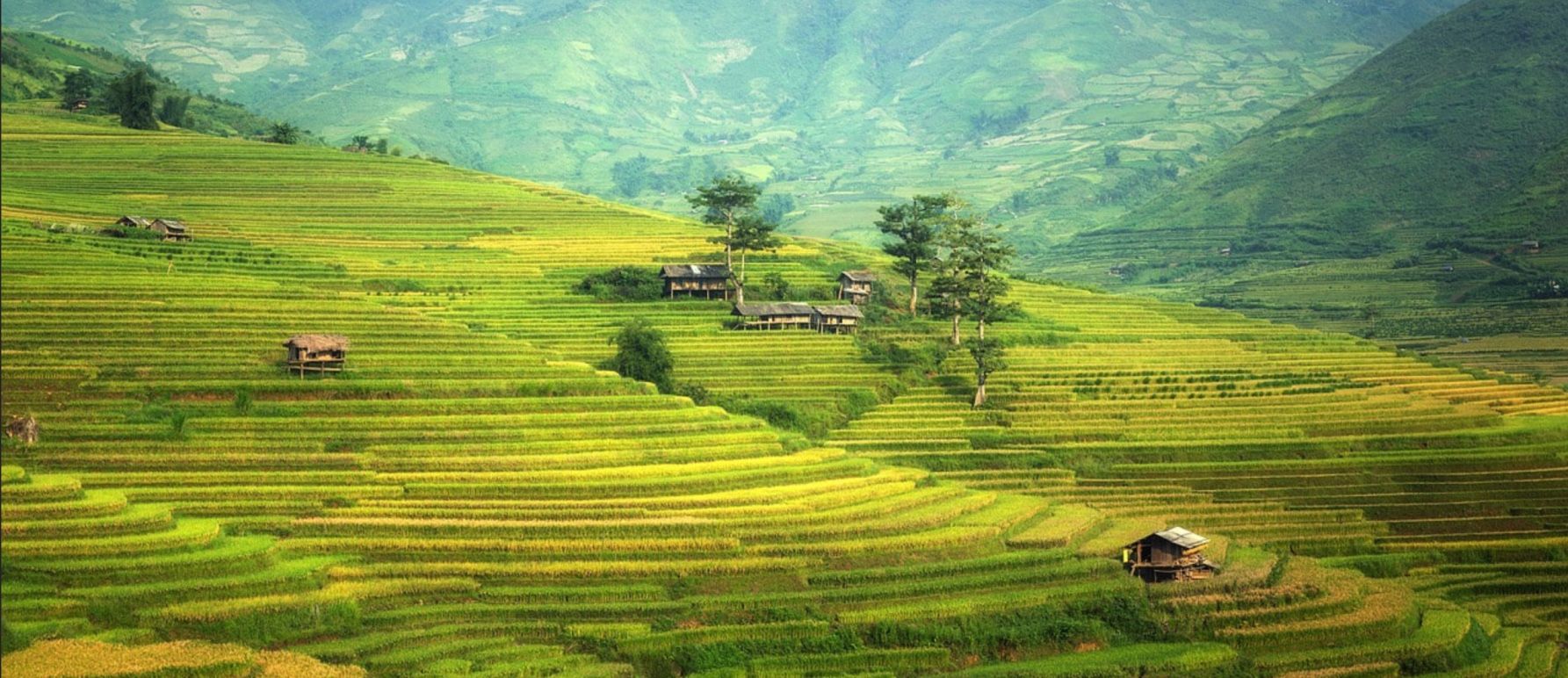
Rice grows throughout Vietnam. In the south and centre, it is planted in flat paddies across river deltas and coastal plains. In the north, the terrain is different. The mountains are high, the valleys are deep, and the slopes are steep. Farming on flat ground was not an option for the communities who settled here, so they cut terraces into the hillsides instead, diverting water from streams to flood each level in sequence from top to bottom. The technique likely originated along the Vietnam-China border and spread through the northern highlands over centuries.
The result is a landscape that changes with the farming calendar. Flooded terraces from May to June reflect the sky. Green rice fills the fields from July through August. The golden harvest arrives in September and October. Each phase looks different and draws a different kind of visitor.
Best time to visit Vietnam’s rice terraces
The calendar below applies across most northern terrace regions, with specific variations noted under each location.
May to June (watering and planting season): Fields are flooded and reflect light and sky. Vivid green shoots appear by late May. This window is less crowded than September and produces strong photography conditions, particularly in early morning.
July to August: Rice is fully green and at its tallest. Heavy rain is possible and can make mountain roads slippery, but the landscape is dense and textured. Mornings are usually clear.
September to October (harvest season): The most photographed period. Fields turn from green to gold as the rice ripens. Harvest begins at different times in different villages, so golden and green fields sometimes appear side by side. This is peak season and accommodation in popular areas books out weeks in advance.
November to April (fallow months): Fields are bare or being prepared for planting. Views are less dramatic but villages are quiet, accommodation is cheaper, and the cultural experience of markets, festivals, and everyday village life is more accessible.
Where is the best place to see rice terraces in Vietnam?
Northern Vietnam is home to the most spectacular terraced rice fields in the country. Regions like Mu Cang Chai, Hoang Su Phi, Sapa, Y Ty, and Pu Luong draw visitors from across the world, particularly during the golden harvest months of September and October. Further south, Tam Coc in Ninh Binh and the Mekong Delta offer completely different but equally compelling rice landscapes. Here are the ten best places to see Vietnam’s rice fields, from the most famous to the most remote.
1. Mu Cang Chai rice terraces
Mu Cang Chai in Yen Bai province, about 350 km west of Hanoi, is the most photographed rice terrace area in Vietnam. The H’mong ethnic minority built and still farms these terraces, which cover more than 2,000 hectares across three main hamlets: La Pan Tan, Che Cu Nha, and Ze Xu Phinh. The fields at La Pan Tan follow the hillside in long, smooth curves. Those at Che Cu Nha form tighter spirals that are most visible from the road above.
Mam Xoi Hill, just outside Mu Cang Chai town, is the single most visited viewpoint, where terraces stack in concentric rings resembling a tray of sticky rice when seen from above. For a different perspective, paragliding over Khau Pha Pass reveals the Cao Pha Valley and Lim Mong Village fields from the sky. Hiring a local guide for a half-day walk through the hamlets rather than driving the main road is a better experience and supports village income directly.
Getting there: Overnight bus from Hanoi’s My Dinh station takes 8-9 hours. No direct train. Private car hire is around 2,500,000-3,000,000 VND from Hanoi.
Best time: Late September to mid-October for gold. Late May for green reflected fields.
2. Hoang Su Phi rice terraces
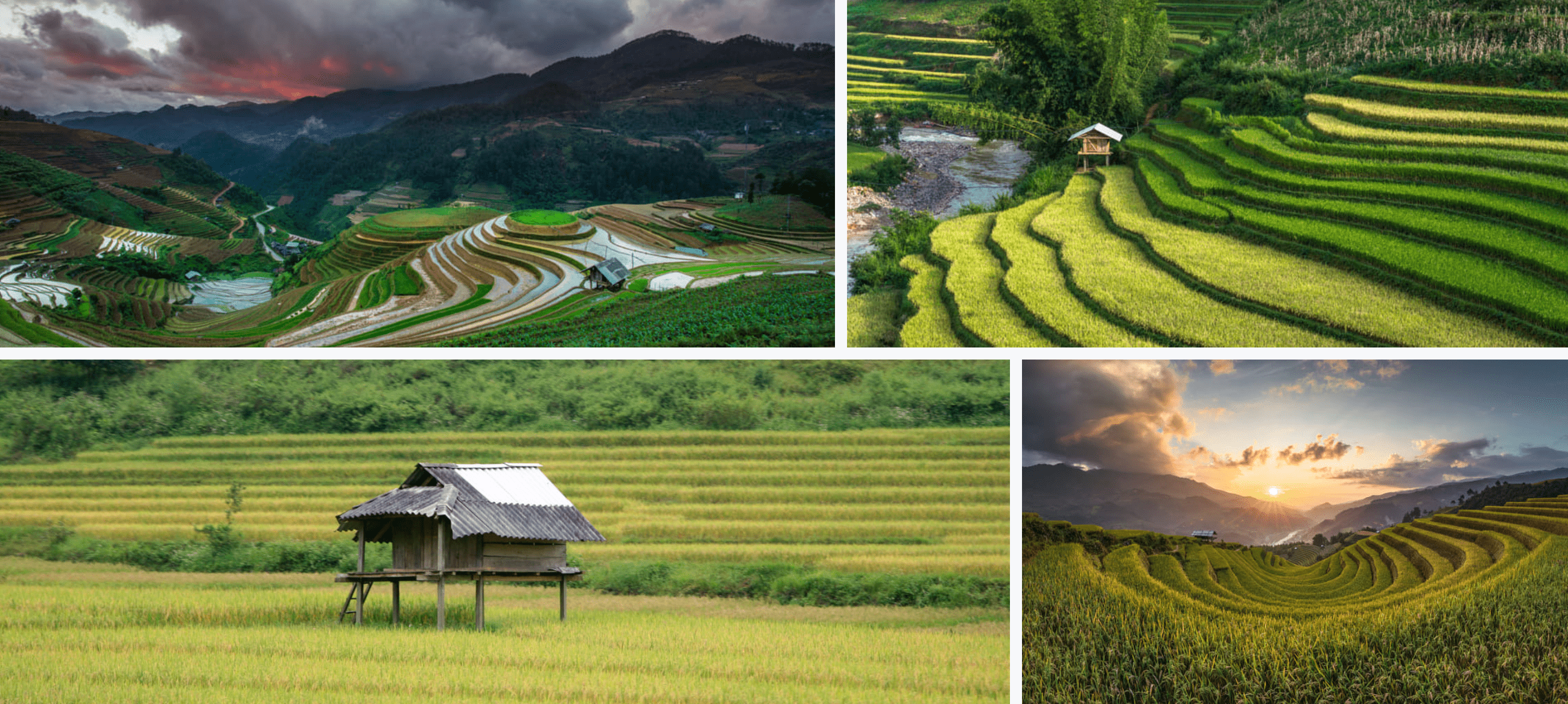
Hoang Su Phi is in Ha Giang province at the foot of the Tay Con Linh mountain range. The terraces here are steeper and narrower than at Mu Cang Chai, cut into sharper slopes and set among dense forest. Dao, La Chi, Nung, and Tay ethnic communities all farm sections of this landscape, each following its own planting and harvest schedule, which means the colour of the fields varies across short distances even in the same season.
The road to Hoang Su Phi is slower and less maintained than routes to better-known areas. This keeps visitor numbers down even during peak season. In autumn, the flooded terraces catch the light and turn the hillsides gold. The weekly market in Hoang Su Phi town draws ethnic minority communities from surrounding villages and is worth building into any itinerary.
Getting there: From Ha Giang City by motorbike or car, around 2-3 hours. From Hanoi, the journey takes a full day by road.
Best time: March to May for flooded terraces and reflections. September to October for harvest gold.
3. Sapa rice terraces
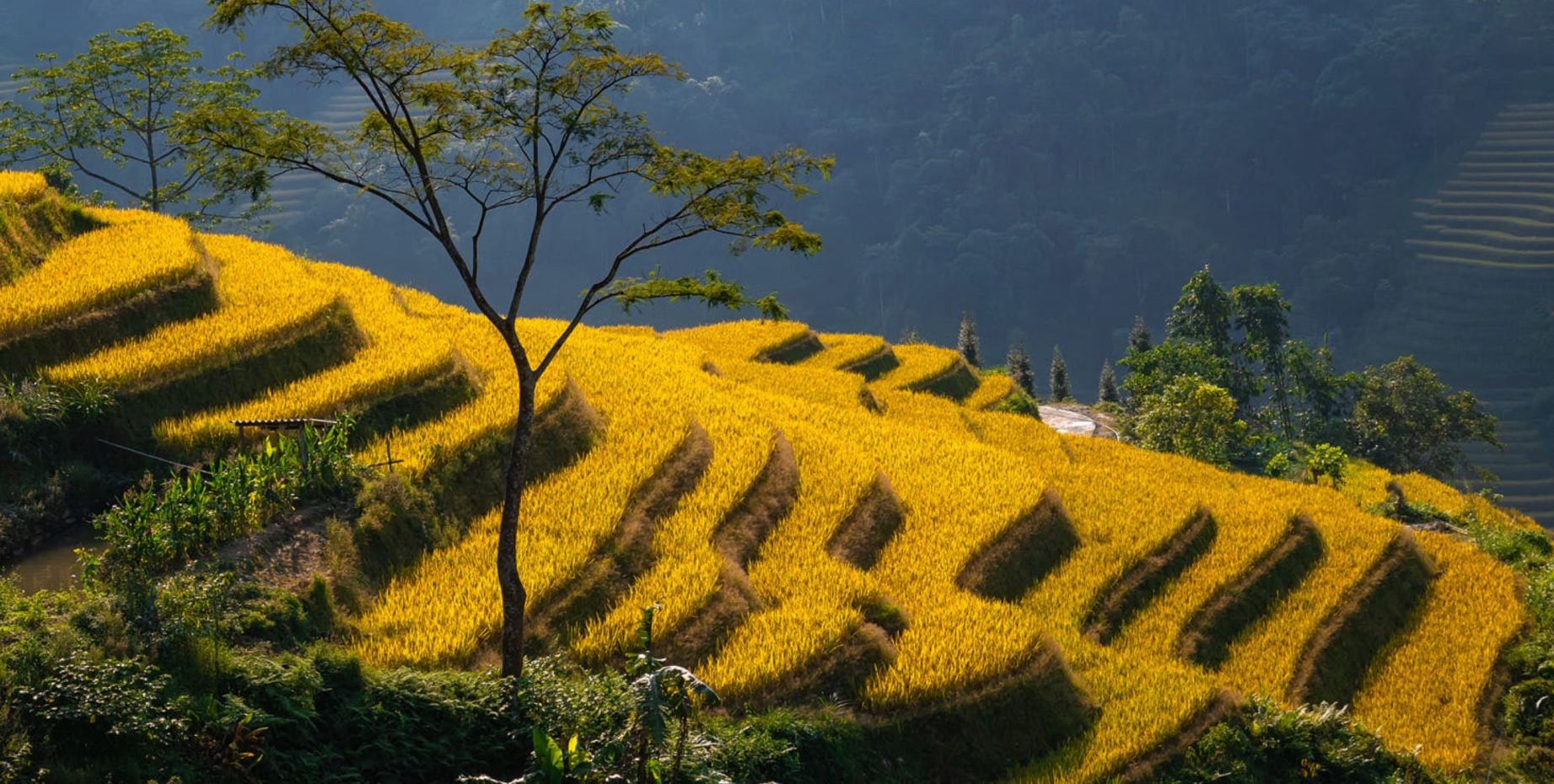
Sapa is a mountain town in Lao Cai province and the most accessible terrace destination from Hanoi. The town sits at around 1,500 m elevation and is surrounded by valleys where Black H’mong, Red Dao, Tay, and Giay communities farm terraced hillsides that descend to fast-running streams. The trek from Sapa town down through Cat Cat village to the valley floor, and then along the river to Lao Chai and Ta Van villages, passes through active rice fields for most of the route.
Sapa has more accommodation options than any other terrace destination in the north, from budget guesthouses to mid-range and luxury hotels. The trade-off is that the town itself is heavily developed and the most-walked trails can feel commercial during peak season. Going further from town, to Y Linh Ho, Ban Ho, or Ban Lech, reduces crowds significantly.
Getting there: Overnight train from Hanoi to Lao Cai (8 hours), then 1 hour by bus or taxi up to Sapa town. Sleeper bus takes 5-6 hours direct.
Best time: Mid-August to early September for clear skies and the green-to-gold transition.
4. Y Ty, Lao Cai
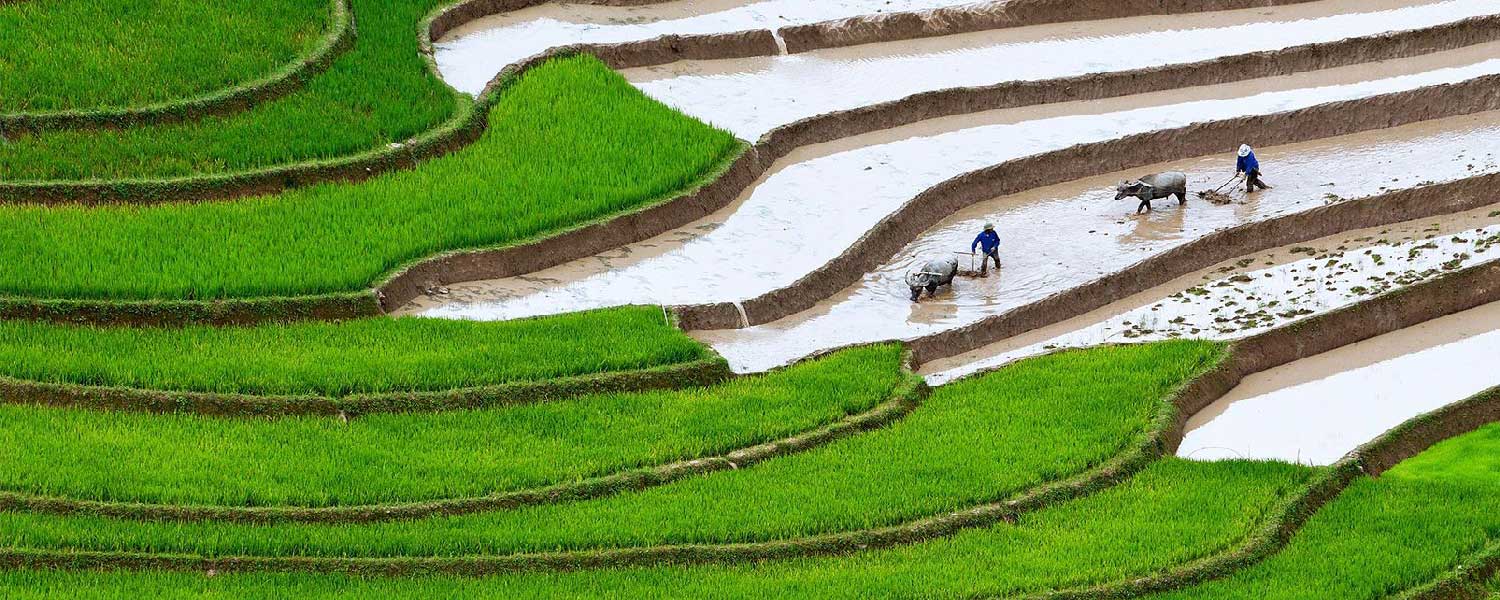
Y Ty is a small community in Bat Xat district, about two hours by road from Sapa. It has earned a reputation in Vietnam as a cloud-hunting destination because morning mist fills the valley below while the peaks above stay clear, producing a sea of cloud effect that is difficult to see anywhere else in the country. The Ha Nhi ethnic minority lives here and the community’s traditional clay-wall, thatched-roof architecture is still intact. Nhiu Co San Mountain, at 2,700 m, is the peak most visitors climb for the cloud and terrace views combined.
The road to Y Ty from Sapa includes sections that are narrow and unpaved in places. A motorbike or four-wheel drive vehicle is more practical than a standard car in wet conditions. The Saturday morning market draws Ha Nhi, Dao, and other minority communities and is the best opportunity to see traditional dress in a setting that is not arranged for tourists.
Getting there: From Sapa by motorbike or jeep, around 2 hours.
Best time: May for watering season and cloud formations. Late September for harvest.
5. Tam Coc, Ninh Binh
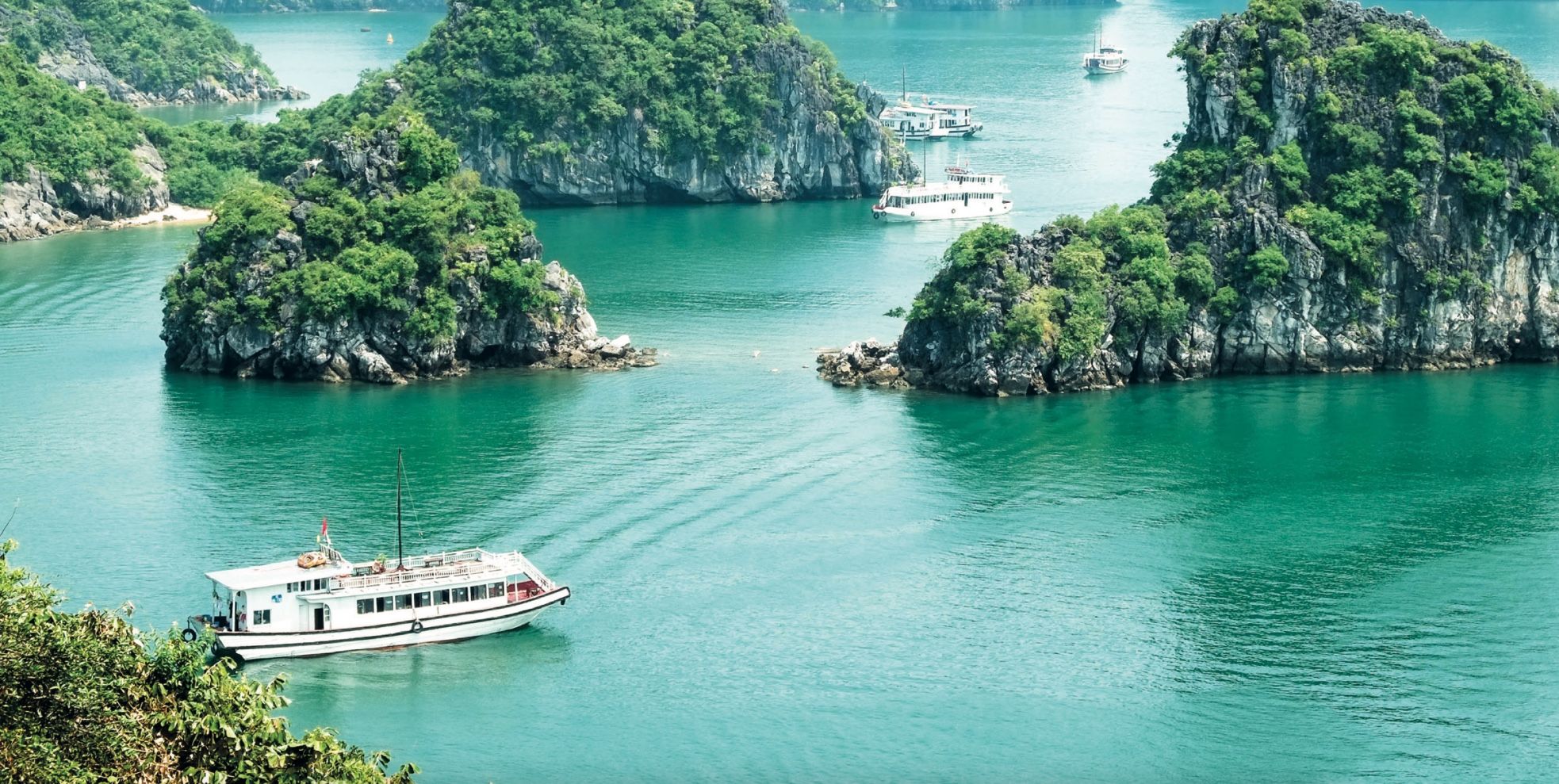
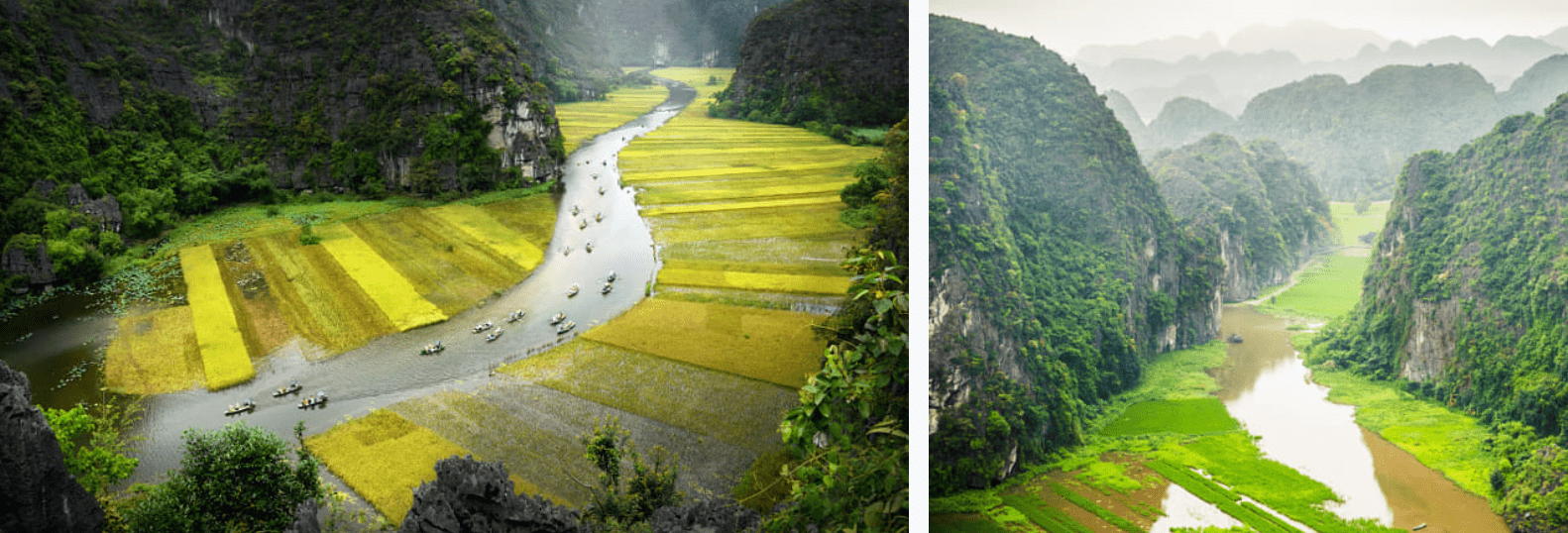
Tam Coc is not a mountain terrace destination but it belongs in any guide to Vietnam’s best rice landscapes. Known as Ha Long Bay on land, the area around Ninh Binh has rice paddies spreading flat across a valley floor while limestone karst peaks rise vertically from the fields. The standard Tam Coc experience is a rowing boat trip along the Ngo Dong River, passing through three low caves with rice fields on both sides. Tam Coc is named after these three caves, and the visual effect of rock, water, and paddy field together is distinct from anything the north’s mountain terraces offer.
The rice terraces of Tam Coc can be visited on a day trip from Hanoi. Staying overnight gives access to early morning light when the valley is quieter and the mist sits between the limestone peaks.
Getting there: About 90 km from Hanoi by road, around 2 hours. Day trips are easy to arrange independently or through a tour operator.
Best time: May to June and September to October for green and gold fields respectively.
6. Hong Thai, Tuyen Quang
Hong Thai in Tuyen Quang province is one of the less-visited rice terrace destinations in northern Vietnam, sitting at a cooler elevation with mountain views on all sides. The terraces wind along the hillsides in long, graceful lines and the landscape changes noticeably with each season. Spring brings wildflowers along the field edges. Summer fills the terraces with dense green rice. Autumn turns the slopes gold. Winter brings low mist that settles in the valleys and stays until mid-morning.
Because Hong Thai sits off the standard tourist circuit, the villages here are quieter and the farming life more visible than in more developed areas. It is a practical addition to any itinerary combining Tuyen Quang province with Ha Giang.
Best time: September to October for harvest gold. March to April for flowers and mild temperatures.
7. Bac Son Valley, Lang Son
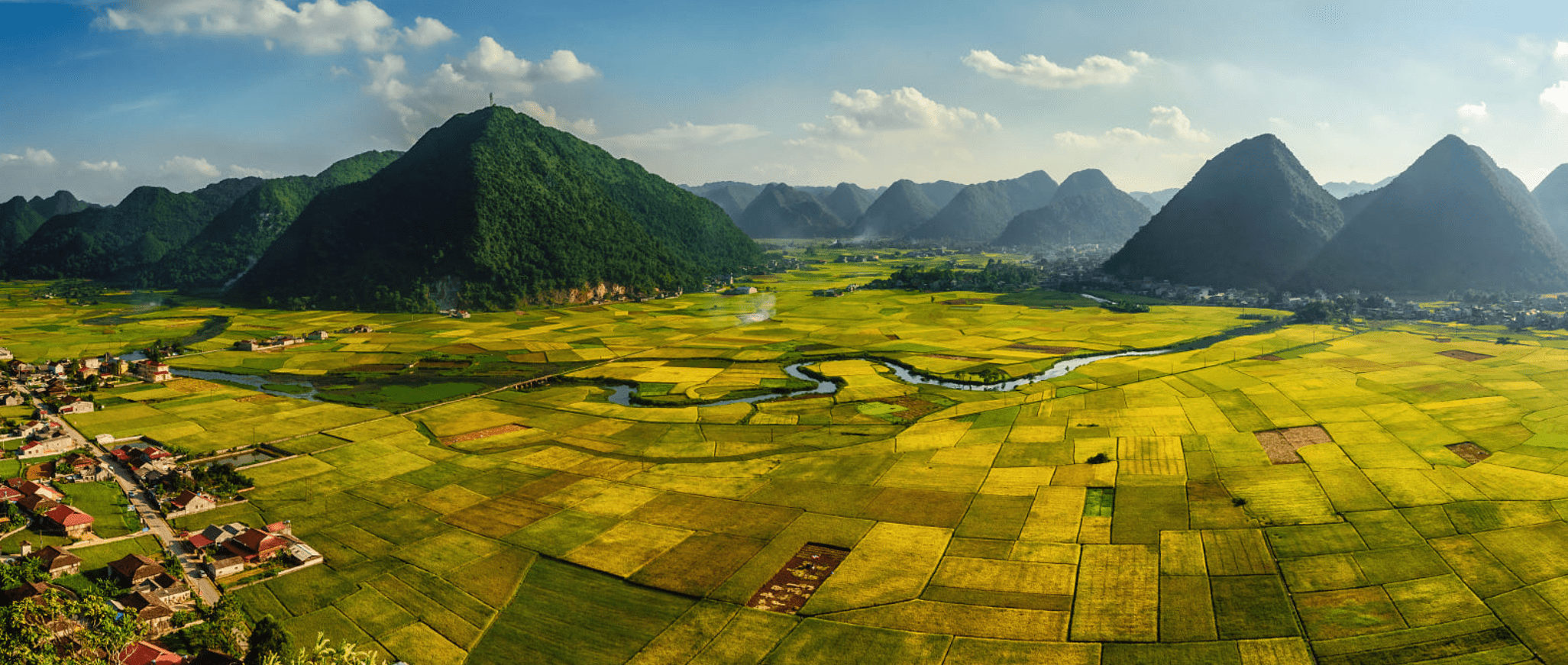
Just 250 km northeast of Hanoi, Bac Son Valley in Lang Son province is a hidden rice terrace destination surrounded by karst peaks and forested ridges. The valley is home to Tho, Nung, Man, and Dzao ethnic communities who still farm the fields with water buffalo. Hiking to Na Lay Peak above the valley gives a panoramic view across the full terrace system. Bac Son also has limestone caves and ruins of the Mac Dynasty Citadel for visitors who want more than rice field scenery.
The valley is easy to reach from Hanoi and works well as a two-day trip, staying overnight in Bac Son town.
Getting there: Around 250 km northeast of Hanoi, approximately 4-5 hours by road.
Best time: April to November.
8. Mai Chau rice fields
Just a 3-hour drive from Hanoi, Mai Chau valley in Hoa Binh province is one of the most accessible rice field destinations in northern Vietnam. The valley floor is wide and flat, farmed by White Thai ethnic communities who still live in traditional stilt houses. The rice paddies fill the valley from edge to edge, framed by low hills on both sides and cut through by small streams. Stilt-house homestays on the edge of the paddies are the standard accommodation and most provide meals cooked by the host family.
Mai Chau works well as a first introduction to northern Vietnam’s rice landscapes for travellers who do not have time for a longer journey north.
Getting there: Bus from Hanoi’s Yen Nghia station, around 3-4 hours. Motorbike from Hanoi via Highway 6 takes around 3 hours.
Best time: May and August to October.
9. Pu Luong rice terraces, Thanh Hoa
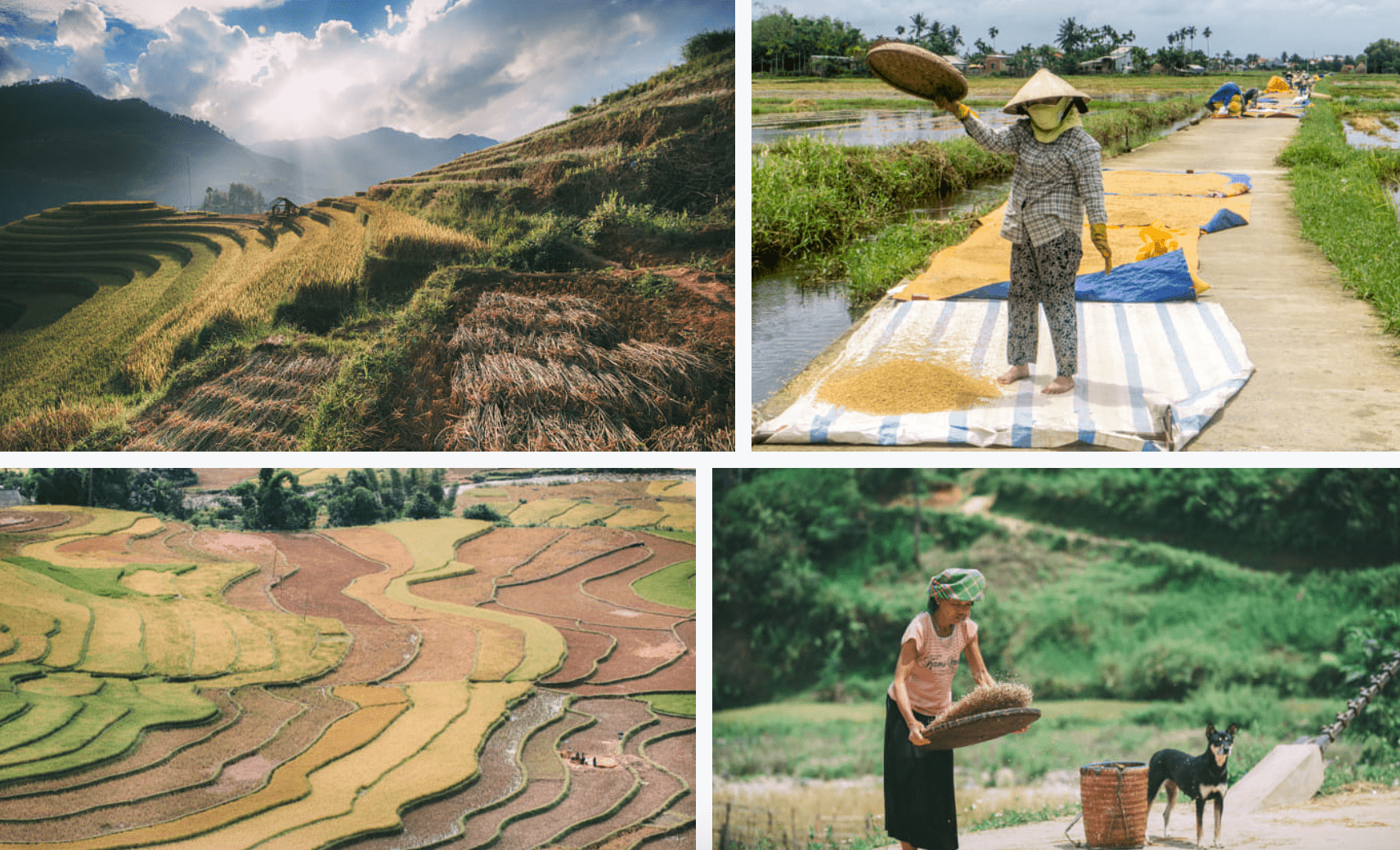
Pu Luong Nature Reserve in Thanh Hoa province, about 160 km from Hanoi, covers 17,662 hectares of forest, terraced rice fields, and river valleys between two limestone ridges. The terraces here are less steep than Mu Cang Chai and the overall landscape is greener and more forested for most of the year. Thai and Muong ethnic communities live in stilt-house villages within the reserve. The Ban Hieu and Ban Kho Muong walking trails pass directly through active farming land where you can watch daily agricultural work at close range.
Pu Luong is a common stop on the motorbike circuit between Hanoi and Mai Chau, which makes it practical to combine with a broader northwest riding trip rather than visiting as a standalone destination.
Getting there: Around 3.5-4 hours from Hanoi by road via Hoa Binh. Bus to Quan Hoa from My Dinh station, then local transport.
Best time: August to October for the green-to-gold transition.
10. Mekong Delta rice fields, Can Tho
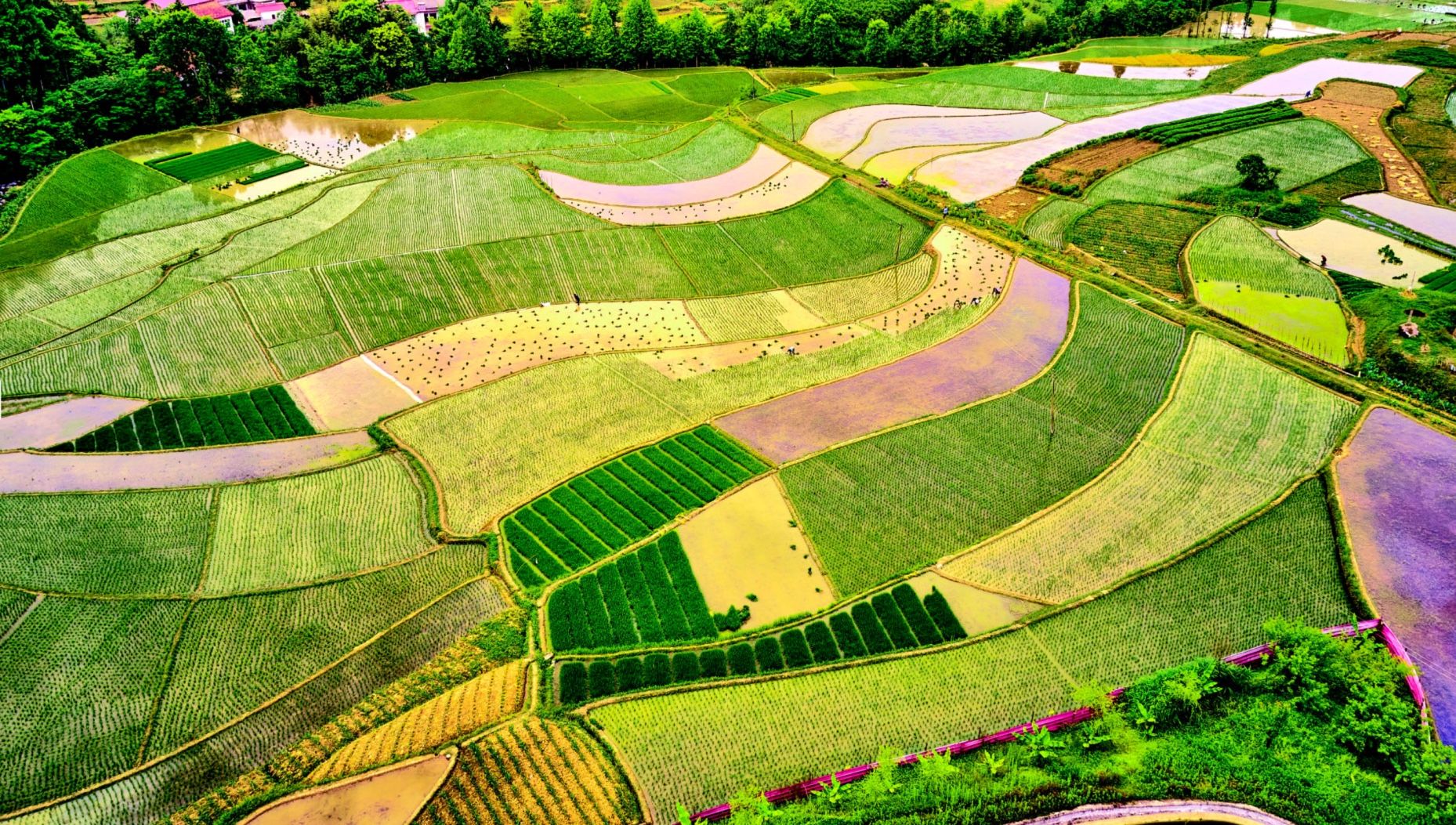
The Mekong Delta in southern Vietnam produces 72% of the country’s rice and is a completely different rice landscape from the terraced north. The fields here are flat, water-fed, and surrounded by a network of rivers and canals. Most trips into the delta begin in Can Tho, the region’s main city and the gateway to its floating markets and canal-side villages. Boat trips along the waterways pass through rice fields, stilted farming settlements, and fruit orchards.
The visual experience is of rice as a large-scale agricultural system rather than a hand-carved landscape. It is a complement to the north rather than a substitute, and worth combining on a motorbike tours in north Vietnam that covers both regions.
Getting there: Flights from Hanoi or Ho Chi Minh City to Can Tho. Bus or boat from Ho Chi Minh City, around 3-4 hours.
Best time: June to August when seasonal floods reshape the delta scenery. Fields are visible year round.
How to get to Vietnam’s rice terraces from Hanoi
Hanoi is the practical starting point for all northern terrace destinations.
Sapa is the most straightforward. An overnight train from Hanoi to Lao Cai takes 8 hours, then a 1-hour bus up the mountain reaches Sapa town. Sleeper buses depart nightly and arrive in 5-6 hours.
Mu Cang Chai has no direct train. An overnight bus from My Dinh takes 8-9 hours. Private car hire is around 2,500,000-3,000,000 VND. Getting from Sapa to Mu Cang Chai directly requires hiring a private vehicle for the 300 km mountain road, around 7-8 hours.
Hoang Su Phi requires going through Ha Giang. Ha Giang is around 5-6 hours from Hanoi by sleeper bus. From Ha Giang City to Hoang Su Phi is another 2-3 hours by road.
Mai Chau and Pu Luong are the closest to Hanoi and the most practical for a two-day trip from the capital, both reachable in 3-4 hours.
Tam Coc is 90 km south of Hanoi, about 2 hours by road and easy to do as a day trip.
Practical notes for visiting rice terraces in Vietnam
Rice fields are active farmland, not ticketed attractions. Most popular viewpoints charge a small entrance fee of 10,000-20,000 VND if they sit on managed land. Walking through fields on unmarked paths risks damaging crops. Staying on designated trails or walking with a local guide avoids this.
Mobile signal is unreliable in most terrace regions outside town centres. Download offline maps of the relevant province before leaving. Cash is necessary as ATMs are available in major towns but not in villages or along mountain roads.
Mountain nights are cold year round, even in summer at elevation. A lightweight thermal layer and a packable waterproof jacket are useful regardless of season. Leeches are present on forest trails during wet season. Closed-toe shoes with grip handle both forest trails and flooded field paths better than sandals.
Hiring a local guide for half-day or full-day treks costs around 200,000-400,000 VND. Guides know the seasonal state of specific fields and support village income directly.
Sample itineraries for Vietnam’s rice terraces
Two days from Hanoi: Mai Chau and Pu Luong
Day one: Depart Hanoi early by bus or motorbike. Arrive Mai Chau by midday. Afternoon walk through stilt-house villages and valley paddies. Overnight homestay with the host family.
Day two: Morning ride to Pu Luong. Walk the Ban Hieu trail through the reserve. Afternoon return to Hanoi via Hoa Binh.
Three days: Sapa and Y Ty
Day one: Overnight train from Hanoi to Lao Cai. Morning arrival, transfer to Sapa. Afternoon trek to Cat Cat and Ta Van villages through terraced valleys.
Day two: Early departure by motorbike or jeep to Y Ty. Morning cloud formations above the valley. Afternoon hike and village walk. Overnight homestay in Y Ty.
Day three: Saturday market in Y Ty if timing allows. Return to Sapa or Lao Cai for evening train back to Hanoi.
Four to five days: Mu Cang Chai and Hoang Su Phi
Depart Hanoi by overnight bus to Mu Cang Chai. Two nights in the valley covering La Pan Tan, Che Cu Nha, and Ze Xu Phinh hamlets. Continue north by private vehicle or motorbike to Hoang Su Phi in Ha Giang province. One to two nights exploring the terrace roads and the weekly market. Return to Hanoi via Ha Giang City by overnight bus.
FAQ: Vietnam rice terraces
When is the best time to visit Vietnam's rice terraces?
Late September to mid-October is harvest season, when fields turn from green to gold. This is the most photographed period and the one most tour operators build itineraries around. Late May to early June, when fields are flooded and green rice is newly planted, is the second most popular window and significantly less crowded. Both seasons produce strong conditions for photography and general visiting. November to April is the fallow period, quieter and cheaper, but the fields have less visual interest.
What is the best time of day to see rice terraces in Vietnam?
Early morning from around 6am to 9am gives the best light and the most mist in the valleys. Sunrise at key viewpoints like La Pan Tan in Mu Cang Chai can be crowded during peak season, but arriving early still produces better conditions than midday when haze reduces visibility across the valleys. That said, local advice matters. A homestay owner at Mu Cang Chai once suggested arriving at viewpoints around 10am when the morning light was still clean but the angle was better for the specific field layout. Always ask your host what is working in the current conditions.
Where is the best place to see rice terraces in Vietnam?
Mu Cang Chai in Yen Bai province is considered the most spectacular single area for terraced rice fields. Hoang Su Phi in Ha Giang province is the best option for remoteness and fewer visitors. Sapa in Lao Cai is the most accessible and has the widest range of accommodation and trekking routes. Y Ty is the best destination for cloud formations combined with intact ethnic minority culture. For a different type of rice landscape, Tam Coc in Ninh Binh shows paddies between limestone karst peaks rather than on mountain slopes.
What are the closest rice terraces to Ho Chi Minh City?
The Mekong Delta is the closest rice landscape to Ho Chi Minh City, around 3-4 hours by bus or boat to Can Tho. The delta does not have terraced hillsides but has large-scale flat paddy fields across a river and canal network. For mountain terraces closer to the south, the Central Highlands around Dalat have some rice fields, but the northern highlands around Sapa, Mu Cang Chai, and Hoang Su Phi are where Vietnam’s iconic terraced fields are concentrated.
What are the closest rice fields to Hanoi?
Tam Coc in Ninh Binh province, about 90 km south of Hanoi, is the most practical day trip for rice field scenery from the capital. Known as Ha Long Bay on land, the area has rice paddies spread across a flat valley floor between limestone peaks. Mai Chau in Hoa Binh province, around 3 hours from Hanoi, is the closest destination for a proper overnight rice field experience with homestay accommodation. Pu Luong in Thanh Hoa, about 4 hours away, is the closest mountain terrace destination to Hanoi worth a two-day trip.
Do I need a guide to visit the rice terraces?
On the main trails around Sapa, Cat Cat, and Ta Van villages, a guide is not necessary. The paths are well-used and marked. In more remote areas like Hoang Su Phi’s back hamlets, Mu Cang Chai’s side roads, and Y Ty’s forest trails, a local guide is useful both for navigation and for knowing which specific fields are at the right growth stage during your visit. Guide fees of 200,000-400,000 VND for a half day are reasonable and the income goes directly to the village.
Is a motorbike the best way to explore Vietnam's rice terraces?
For most northern terrace regions, yes. A motorbike allows you to stop at any point along the road, take side routes that buses cannot access, and cover several viewpoints in a single day at your own pace. Sapa is the exception, where the main terrace treks are done on foot and a motorbike is less useful within the valley itself. For Mu Cang Chai, Hoang Su Phi, and the Ha Giang south region, a 110-125 cc semi-automatic bike handles the roads without difficulty. The mountain passes in the far north require confidence and experience on two wheels.
About the author
Hamid is a travel writer who has spent years moving through Vietnam, Cambodia, Laos, and Thailand. He writes about places, culture, and daily life with a preference for ground-level detail over general impressions, and has logged more hours on mountain roads in northern Vietnam than he would care to count. He believes the most useful travel knowledge comes from living like a local rather than passing through as a visitor.