




Vietnam’s currency is the Vietnamese đồng (₫ or VND), and cash is still king for most daily transactions. Notes run from 10,000 VND to 500,000 VND — Vietnam stopped using coins in 2011, which keeps your wallet light. The zeros trip up many first-time visitors: remove three zeros to get a working number, then divide by 25 to convert roughly to USD (1 USD ≈ 25,000 VND as of early 2025).
What is the currency in Vietnam?
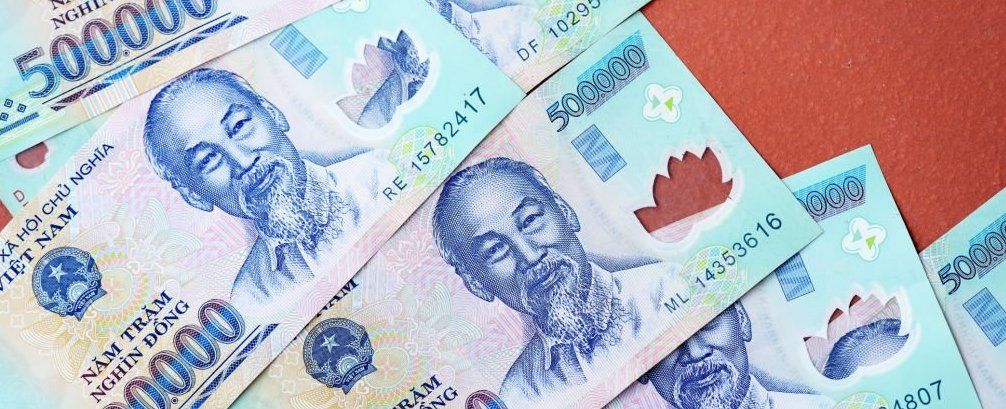
The official Vietnam currency is the Vietnamese đồng, written as ₫ or VND. Notes in circulation come in two types: small paper notes (500₫, 1,000₫, 2,000₫, 5,000₫) and larger polymer notes (10,000₫, 20,000₫, 50,000₫, 100,000₫, 200,000₫, and 500,000₫). All notes carry a portrait of President Ho Chi Minh.
A quick mental shortcut: drop three zeros to simplify. 200,000 VND becomes 200, then divide by 25 to get roughly USD 8. Watch the 20,000 VND and 500,000 VND notes — both are blue and easy to confuse when paying quickly.
Immerse yourself in the best experiences Vietnam has to offer with our carefully designed trip that caters to the needs of most discerning travelers, check out Vietnam private tours
| Currency | Exchange Rate (April 2026) |
|---|---|
| USD | 26,140 VND |
| EUR | 28,950 VND |
| JPY | 174 VND |
| GBP | 33,294 VND |
| AUD | 17,000 VND |
| CAD | 18,620 VND |
| SGD | 19,389 VND |
History of the Vietnamese đồng
Vietnam replaced the French Indochinese piastre with the đồng in 1953. After reunification in 1975, the country introduced a unified đồng to replace the separate northern and southern currencies. The đồng became Vietnam’s sole official currency on May 3, 1978. Coins were phased out of circulation in 2011, leaving only paper and polymer notes in use today.
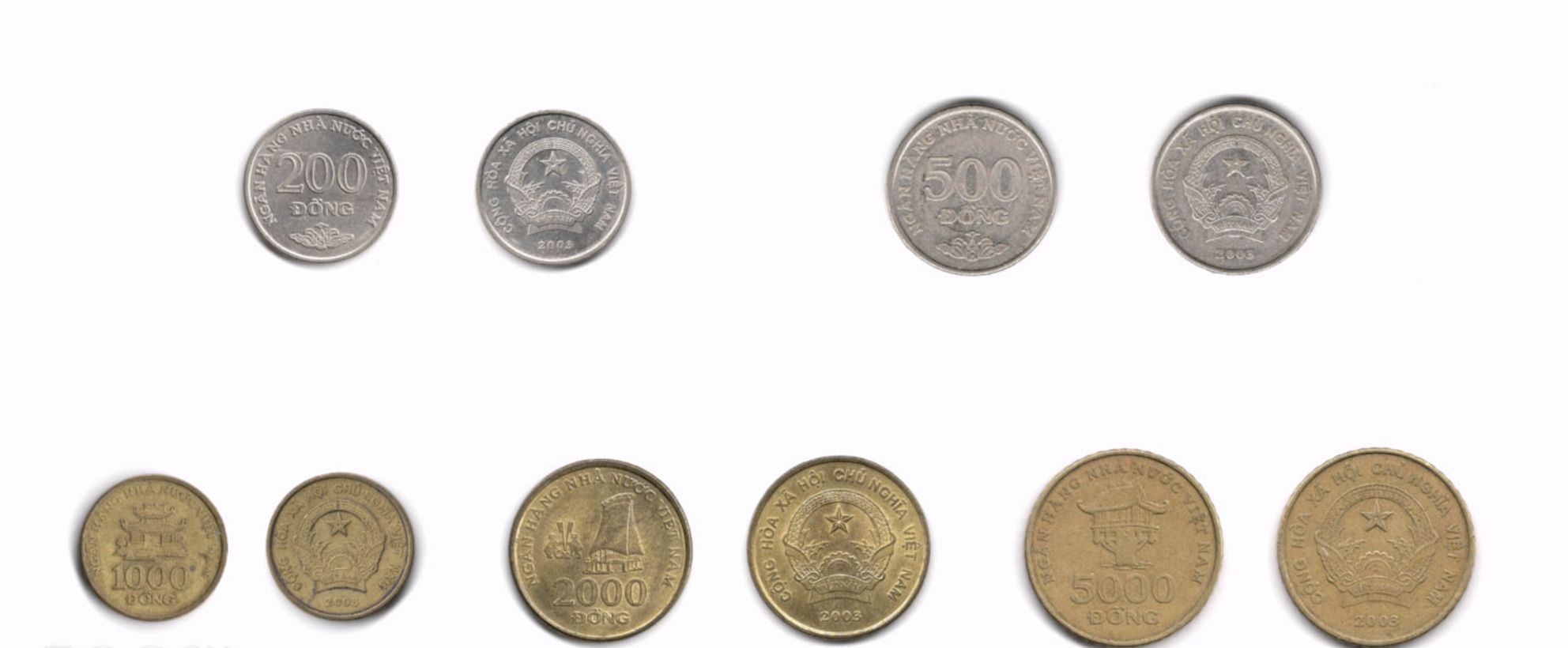
Vietnamese dong denominations: which notes are in circulation
Current denominations in circulation are paper notes of 500₫, 1,000₫, 2,000₫, and 5,000₫, and polymer notes of 10,000₫, 20,000₫, 50,000₫, 100,000₫, 200,000₫, and 500,000₫. All feature Ho Chi Minh on the front.
TIP: The 20,000 VND and 500,000 VND notes are both predominantly blue and similar in size. Double-check before handing over cash, especially in dim lighting or when in a hurry.
How to withdraw cash in Vietnam: ATMs and money exchange
On arrival, the easiest options are the ATMs in the airport arrival hall or the money exchange counters before you exit. Both work reliably. Visa and Mastercard are accepted at more than 25,000 ATMs across Vietnam, from major cities to smaller towns. ATMs dispense in Vietnamese dong only, regardless of your home currency.
ATM withdrawal limits and fees in Vietnam
Withdrawal limits and fees vary by bank. Vietnamese local banks generally offer lower fees than international banks. Using an international card at a Vietnamese ATM typically costs between 20,000 and 55,000 VND per transaction, depending on the machine. Withdrawal limits per transaction are:
- Vietcombank: up to 2,000,000₫
- VietinBank: up to 2,000,000₫
- VPBank: up to 5,000,000₫
- HSBC: up to 8,000,000₫
- Citibank: up to 8,000,000₫
- Commonwealth Bank: up to 10,000,000₫
- ANZ: up to 10,000,000₫
TIP: If you’re heading to remote areas — the northwest highlands, the Mekong Delta backwaters, or small border towns — withdraw enough cash before you go. ATMs are scarce and some villages are cash-only.

Card payments in Vietnam
Most cafes, hotels, and restaurants in cities accept Visa and Mastercard. Street vendors, wet markets, and small local eateries are cash-only. As of 2026, several Vietnamese banks including Sacombank, BIDV, Vietcombank, and VPBank also accept American Express.
Many businesses and taxi services now support Visa contactless payments — tap your card directly on the terminal. Conversion rates and foreign transaction fees depend on your card provider, so check before you travel.
Vietnam currency exchange rates by country
The State Bank of Vietnam set the central rate at 26,140 VND per 1 USD as of April 2026. Rates below are based on Vietcombank’s published exchange rates. Rates change daily, so check the latest before departure. USD, EUR, and GBP are accepted and exchanged at banks, licensed exchange offices, gold shops, and hotel desks throughout Vietnam. Other currencies such as Philippine pesos, Indian rupees, and Thai baht are also commonly exchanged.
USD to Vietnamese dong: how much is $100 in Vietnam?
At April 2026 rates, 1 USD = approximately 26,140 VND, so $100 USD = 2,614,000 VND. The US dollar is the most widely accepted and easily exchanged foreign currency in Vietnam. You can pay for hotels, tours, and some services directly in USD, but the rate offered will usually be worse than the official bank rate. Supermarkets, street vendors, and restaurants only accept Vietnamese dong.
Euro to Vietnamese dong exchange rate
As of April 2026, 1 EUR = approximately 28,950 VND. The euro is straightforward to exchange at airports, banks, and licensed exchange offices across Vietnam. Bring new, undamaged banknotes, old or worn euro notes are exchanged at lower rates or refused. You’ll need a valid passport to exchange at a bank.
Japanese yen to Vietnamese dong
As of April 2026, 1 JPY = 174 VND. Japanese yen is not widely accepted in shops or hotels, so exchange it on arrival. Smaller local bank branches may not offer JPY exchange; go to the airport or a major city branch. Bring new, undamaged notes, torn or heavily marked banknotes will be refused or exchanged at a lower rate.
British pounds to Vietnamese dong
As of April 2026, 1 GBP = approximately 33,294 VND. GBP exchanges smoothly at major Vietnamese banks including Vietcombank, Techcombank, and BIDV, as well as at gold shops (licensed money changers). Airport rates are slightly lower than city rates but still fair. Hotels and tourist offices typically do not accept GBP directly, so exchange into dong before paying bills.
Australian dollars to Vietnamese dong
As of April 2026, 1 AUD = approximately 17,000 VND. Exchange at banks or licensed exchange offices for the best rates. Larger denomination AUD notes get slightly better rates than smaller ones. Hotels and service providers may not accept AUD, so convert before checking in.
Canadian dollars to Vietnamese dong
As of April 2026, 1 CAD = approximately 18,620 VND, so $100 CAD = 1,832,000 VND. Exchange at major state bank branches or licensed offices for the best rate. Airport counters are reliable but offer slightly lower rates than city banks. Markets, restaurants, and local vendors only accept VND.
Singapore dollars to Vietnamese dong
As of April 2026, 1 SGD = 18,389 VND. Vietnam is a popular destination for Singaporean travelers, and SGD is accepted at most major exchange points in Hanoi, Ho Chi Minh City, and Da Nang. Despite this, hotels and tourism services rarely accept SGD directly. Exchange on arrival at the airport or at a city bank before paying for accommodation or tours.
Where to exchange money in Vietnam
The best exchange rates in Vietnam are at gold shops (licensed money changers) and state banks. Airports offer competitive rates, better than most home-country options, and are the most convenient on arrival. Avoid unlicensed street vendors.
Airports
All three international airports, Hanoi (Noi Bai), Da Nang, and Ho Chi Minh City (Tan Son Nhat), have multiple exchange counters in the arrival hall. Rates are fair and much better than exchanging before departure in most Western countries. USD, GBP, AUD, CAD, and THB are the most reliably accepted. Bring new, clean banknotes for the best rate.
Banks
Banks are the safest and most transparent place to exchange currency. Rates are slightly lower than gold shops, typically by 5 to 10 VND per unit, but there are no hidden fees. You’ll need a valid passport and visa. Vietcombank, Techcombank, and BIDV are the most reliable options across Vietnam.
Gold shops (money changers)
Licensed gold shops consistently offer the highest exchange rates, often beating banks. Before handing over cash, confirm the exact rate and final VND amount you’ll receive. Reputable shops are common in Hanoi’s Old Quarter and Ho Chi Minh City’s District 1. Avoid any shop that is reluctant to state the rate clearly upfront.
Tips for exchanging money in Vietnam
Always carry your passport when exchanging money — banks and licensed offices are required to photocopy it. Bring new, unmarked banknotes in any currency; torn, worn, or pen-marked notes are refused outright by most banks and accepted only at reduced rates by gold shops. If you’re unsure whether to exchange at the airport or wait for the city, exchange a small amount at the airport to cover your first day, then get the balance at a bank or gold shop once you’re settled.
Useful tips for cash and payments in Vietnam
Getting cash from your debit card in Vietnam
You can request a cash advance at a bank branch, but most staff will direct you to the ATM. If the branch is quiet and a staff member is available to help, you may avoid the ATM fee — though your home bank’s foreign transaction fee still applies. Bring your passport and visa for any in-branch transaction.
What 10 USD can buy you in Vietnam
10 USD is roughly 261,400 VND and goes further in Vietnam than in most other Southeast Asian destinations. Here are a few things that fall within that budget:
A full local meal for two at a street restaurant or market stall, including rice, grilled meat, and drinks. A one-hour traditional massage at a local spa away from the tourist center, prices rise significantly the closer you get to hotel zones. A fresh pint of bia hoi (Vietnamese draught beer), which is brewed daily and typically served for 10,000 to 20,000 VND per glass at street-side stalls. A cup of Vietnamese black coffee costs 25,000 to 40,000 VND at a local cafe. A 100g bag of Vietnamese ground coffee runs around 150,000 VND, depending on the bean. Most museum and attraction entry tickets cost under 50,000 VND, so a single day of sightseeing stays well within budget.
- Learn more about Vietnamese massage
- A guide to Vietnamese coffee
- If you need to know then → Top things to see in Ho Chi Minh City
Currency exchange in Vietnam
How easy is it to find an ATM in Vietnam?
ATMs are widely available in both major cities like Ho Chi Minh City, Hanoi, and Da Nang, and in smaller towns. Most are in tourist areas and operate 24 hours a day, 7 days a week. Use Google Maps to search “ATM near me” or look for signage from TP Bank, Vietcombank, or Sacombank. Most machines accept Visa, Mastercard, UnionPay, and JCB, check the card logos on the machine before inserting yours.
Can I withdraw cash in Vietnam?
Yes. All ATMs in Vietnam dispense Vietnamese dong only, regardless of your home currency. The amount is converted automatically from your currency to VND at the bank’s exchange rate at the time of withdrawal.
What are the ATM fees in Vietnam?
Fees depend on both the local bank and your home bank. For international cards, transaction fees as of January 2026 are:
- Agribank: 22,000 VND
- BIDV, Sacombank, VPBank: 30,000 VND
- ANZ: 40,000 VND
- Vietcombank: 50,000 VND
- Citibank: 55,000 VND
- Techcombank: 0.15% of total withdrawal
Your home bank may also charge a separate foreign transaction fee. Check both before you travel.
Which ATMs are best to use in Vietnam?
The most reliable and widely available ATMs in Vietnam belong to these local banks:
- TP Bank
- VietinBank
- Vietcombank
- Sacombank
- VPBank
- Techcombank